Mango Washing, Waxing, Drying and Grading Line
The automatic mango fruit washing waxing and grading line can continuously brush and polish, dry mango at room temperature, spray wax, and grade mangoes and other fruits. This mango processing line will not damage the mango epidermis, it adopts a special wax spray system that is continuously adjustable, efficient drying system, low temperature and low consumption. The waxed mangoes are automatically allocated to designated areas according to different diameter/weight ranges for packaging processing. This processing line is widely used in apples, pears, mangoes, oranges, lemons, grapefruit, peaches and other similar fruits and vegetables. We can customize it according to customer’s requirements.
Mango Washing, Drying and Waxing Process
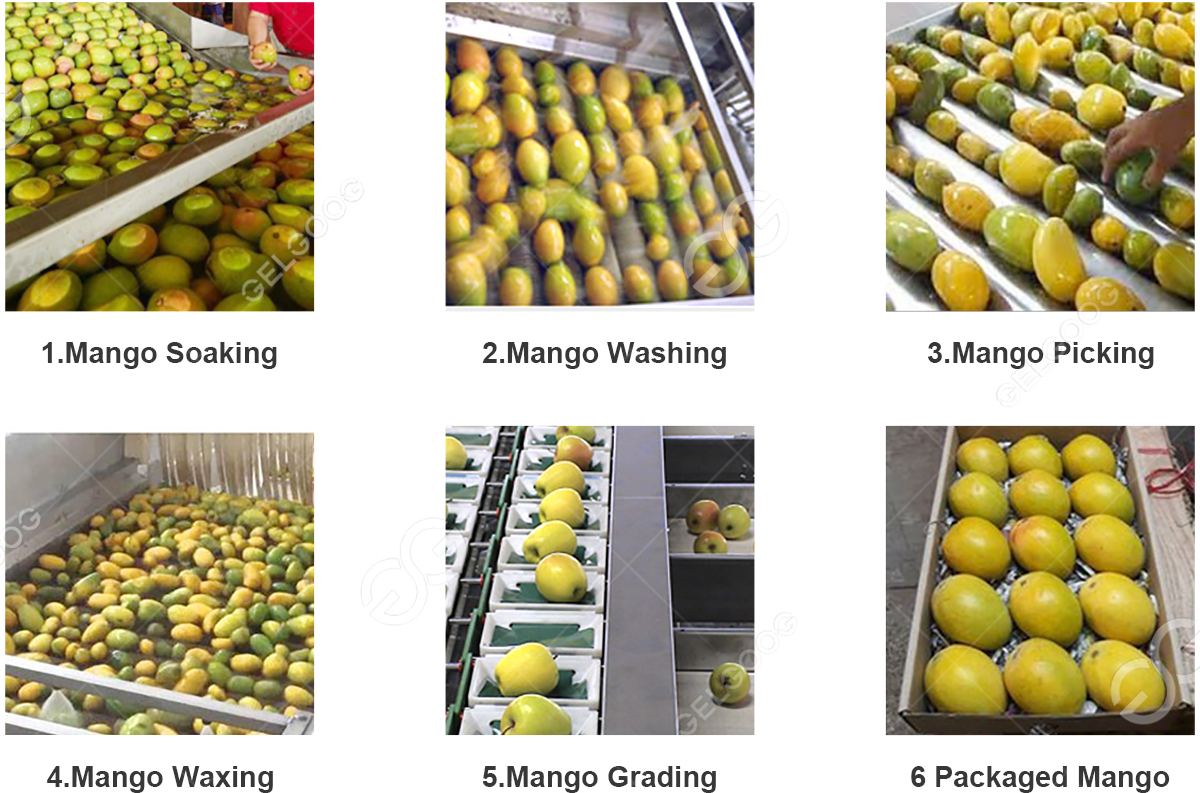
Fresh mangoes → Mango washing and lifting → Mango sorting → Mango scrubbing → Mango polishing and dehydration → Mango waxing and drying → Mango size/weight grading → Finished packaging
A typical mango washing and waxing line includes the following steps:
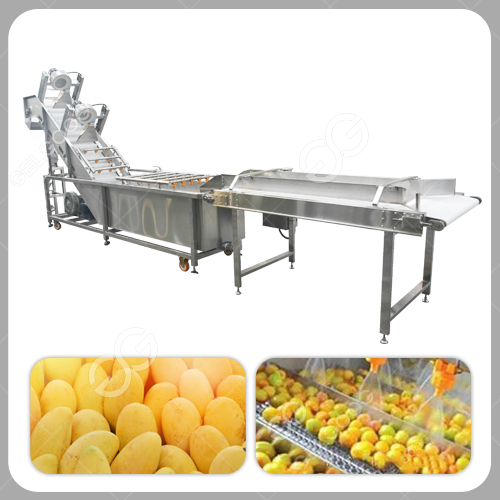
Mango cleaning and elevating: The unique large pool is suitable for cleaning fresh mangoes in large batches. It can soak the mangoes and prevent the mangoes from colliding with each other when poured into the pool, which will damage the mango epidermis. After initial soaking, mangoes generally cannot be thoroughly cleaned, and the surface of mangoes needs to be brushed with a soft brush.
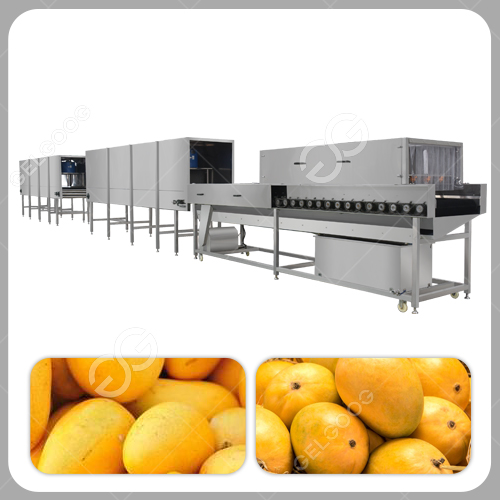
Mango air-drying: The mango air-drying line is dried by a large air volume and low noise fan. The airflow generated by the fan is sprayed onto the surface of the mango through the nozzle, and the reverse conveying and reverse wind design are used to dry the mango thoroughly and prevent dead ends. It can save the time required for natural drying of mangoes and improve the efficiency of mango processing.
Mango waxing: The mango waxing machine adopts a high-power liquid wax pump, which can continuously supply wax, and can be freely adjusted according to the hourly mango processing capacity requirements and the demand for wax volume of different fruits, and the wax spray nozzle has a good atomization effect. Waxed mangoes have a brighter appearance and can increase the selling price of mangoes.
Mango grading: The mango grading machine drives the rollers on the grading bed to move forward and parallel through the double helix rotation, and gradually increases the gap between the rollers to achieve the corresponding size of the mango. The mangoes are dropped onto the conveyor belt from the gap between the rollers, so as to complete the fruit selection.
Mango Washing Waxing Machine Parameter
| Machine Name | Length(m) | Width(m) | Height(m) | Power |
| Soaking pool | 6.47 | 1.55 | 1.8 | 1.5KW |
| Lifting | 3.5 | 1.2 | 0.9 | 1.1KW |
| Brush type washing machine | 4.5 | 1.23 | 1.8 | 3KW |
| Air dryer | 5.05 | 1.28 | 2.04 | 1.1KW |
| Waxing machine | 2 | 1.3 | 1.7 | 1.5KW |
| Air dryer | 5.05 | 1.28 | 2.04 | 1.1KW |
| Conveyor | 6.07 | 0.6 | 1.1 | 0.55KW |
Mango Washing and Grading Line Advantages
High efficiency, simple operation, low power consumption and low noise;
It does not damage mango skin tissue, increases the brightness of mangoes, and prolongs the shelf life of mangoes;
We provide customized services so that our solutions can meet the needs of our customers according to the size of their operations;
Wide range of applications, suitable for apples, pears, mangoes, oranges, lemons, grapefruit, peaches and other similar fruits and vegetables;
The whole set of equipment is made of 304 food-grade stainless steel to ensure the cleanliness and hygiene of mangoes and other fruits during processing;
Share This Post,Choose Your Platform!
Mango Grading Methods and Standards
Experts in mango grading note that grading is a crucial post-harvest step. By grading mangoes, packing facilities can effectively categorize and organize the fruit to meet the specific requirements of different clients, packaging formats, and sales channels.
GELGOOG can configure a mango grading system tailored to your chosen grading method and production capacity.
1. Grading by Size
Grading by size involves categorizing mangoes based on their dimensions (such as diameter or other pre-set size ranges). Depending on the equipment design, the system can sort mangoes using rollers or adjustable grading gaps.
This method is ideal when clients require consistency in the size of the mangoes within each package.
2. Grading by Weight
Grading by weight involves categorizing mangoes based on how much they weigh. Using weighing and sorting systems, operators can set specific weight parameters for different grades.
This approach is highly suitable when buyers have precise requirements regarding mango weight, or when a packing facility needs to ensure that the total product weight in each package remains consistent.
3. Sorting by Quality and Appearance
Sorting by quality and appearance focuses on identifying characteristics such as color, surface blemishes, or other quality attributes—features that cannot typically be determined through size or weight grading alone. If your project requires sorting based on color, surface defects, or other quality traits, you may need to incorporate additional inspection equipment or utilize optical sorting technology.
The specific system you choose will depend on your required inspection standards, the variety of mangoes, and your budget.
Recommended products
Get In Touch Now
Lorem ipsum dolor sit amet, consectetur adipiscing elit. Ut elit tellus, luctus nec ullamcorper mattis, pulvinar dapibus leo.