

Mango sorting is a step in modern fruit processing and export packing. It helps businesses classify mangoes into grades improve product consistency and increase market value.
Today two common technologies are used in mango grading systems: optical sorting and weight sorting. Both methods can improve sorting efficiency. They work in different ways and serve different purposes.
So what is the difference between mango sorting and weight sorting? Which method is better, for your mango processing business?
In this guide we will compare their working principles, advantages, applications and costs to help you choose the mango sorting solution.
- What Is Mango Optical Sorting?
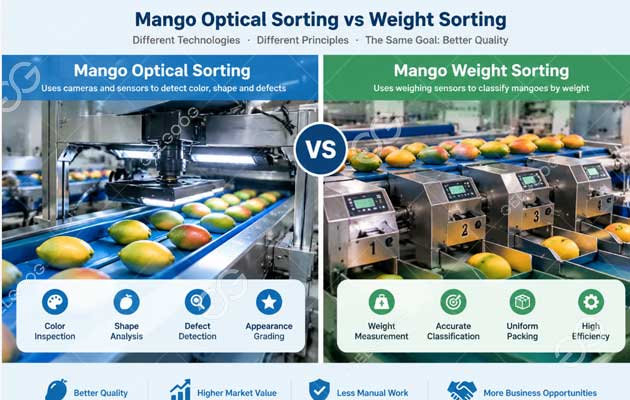
Mango optical sorting is a technology that uses cameras, optical sensors and image processing systems to look at mangoes
As mangoes go along the conveyor belt cameras take pictures of each fruit. The system looks at the pictures. Finds out different things about the way the mango looks.
Things that are checked include:
- Mango color and how even the color’s
- Fruit size and the shape it has
- Marks on the surface and small problems on the outside
- Bumps and damage, to the skin
- Overall look and appearance of the fruit
After the system checks everything the machine sends the mangoes to different places depending on how good they are.
Advantages of Mango Optical Sorting
1. Detect External Defects
Optical sorting systems can identify visible defects such as dark spots, skin damage, and uneven coloring. This helps remove unsuitable mangoes before packaging.
2. Improve Product Appearance
Mangoes can be classified according to color, shape, and surface quality. This is especially useful for premium fresh mango markets.
3. Reduce Manual Inspection
Automatic camera inspection reduces the need for workers to check every mango individually.
4. Support Multiple Sorting Standards
The inspection settings can be adjusted according to mango varieties, customer requirements, and market standards.
How Does an Automatic Mango Sorting Line Work?
An automatic mango sorting line can combine several processing and grading stages.
A typical fresh mango sorting process includes:
Step 1: Mango Feeding
Fresh mangoes are transferred to the conveyor system for continuous processing.
Step 2: Mango Washing
The mangoes pass through a washing machine to remove soil, dust, and other surface impurities.
Step 3: Air Drying
Air drying removes surface water before further inspection, waxing, or grading.
Step 4: Optical Inspection
Cameras and sensors inspect mango color, shape, and visible surface defects when optical sorting equipment is included.
Step 5: Weight Grading
Electronic weighing sensors measure individual mango weights and classify them into preset grades.
Step 6: Automatic Sorting and Collection
The sorting system directs mangoes into different outlets according to the selected grading standards.
Step 7: Packing
Graded mangoes are collected and packed according to customer requirements.
The complete line can be customized according to processing capacity, mango varieties, and the required sorting functions.
Frequently Asked Questions
1. What is the difference between optical sorting and weight sorting?
Optical sorting uses cameras and sensors to inspect mango appearance, including color, shape, and visible defects. Weight sorting uses weighing sensors to classify mangoes according to their individual weight.
2. Can a mango sorting machine sort by both weight and color?
Yes. An integrated mango sorting system can combine optical inspection and electronic weighing to classify mangoes by appearance and weight.
3. Is optical sorting better than weight sorting?
Neither method is always better. Optical sorting is more suitable for visual quality inspection, while weight sorting is better for weight classification and uniform packing.
4. Can a mango grading machine detect rotten mangoes?
Optical systems can identify some visible signs of decay, such as dark spots and surface damage. However, internal defects cannot always be detected by standard RGB cameras. Specialized inspection technologies may be required.
5. How many grades can a mango sorting machine produce?
The number of grading outlets depends on the machine configuration. It can be customized according to weight ranges, size categories, or visual quality requirements.
6. Can the mango sorting line be connected to a washing and waxing machine?
Yes. A mango sorting and grading system can be integrated with washing, air drying, waxing, and packing equipment to create a complete processing line.
7. How do I choose between a weight grader and an optical sorter?
First, identify your main grading requirements. If you mainly need uniform weight, choose a weight grader. If you need to inspect color and external defects, consider optical sorting. If both are important, an integrated system may be the best choice