

The global mango industry is becoming increasingly competitive, making consistent fruit quality and efficient packing more important than ever. Whether you supply supermarkets, exporters, or food processing plants, your sorting method directly impacts productivity, labor costs, and customer satisfaction.
If you’re deciding between manual vs automatic mango sorting, this guide explains the advantages of each approach and why more commercial growers and packing houses are investing in intelligent mango sorting technology.
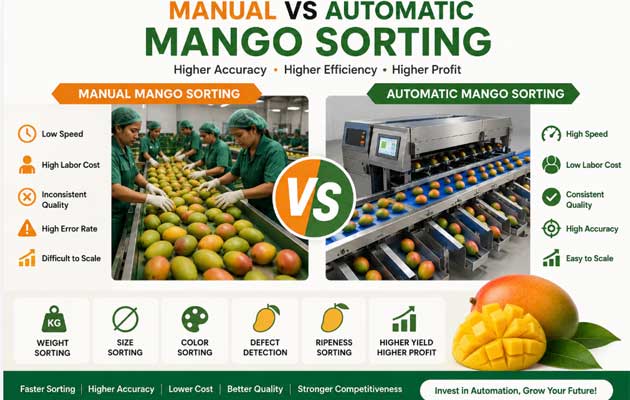
What Is Manual Mango Sorting?
Manual mango sorting relies on workers to inspect and classify fruit based on:
- Size
- Weight
- Color
- External defects
- Ripeness
While manual grading requires a relatively low initial investment, it becomes difficult to maintain consistent quality as production volume increases.
Advantages
- Low equipment investment
- Easy to start for small farms
- Flexible for mixed fruit batches
Limitations
- High labor costs
- Slow sorting speed
- Inconsistent grading standards
- Worker fatigue reduces accuracy
- Difficult to scale production
For exporters supplying premium markets, inconsistent grading may result in customer complaints or rejected shipments.
What Is Automatic Mango Sorting?
An automatic mango sorting machine uses advanced weighing systems, machine vision, AI cameras, and intelligent software to classify every mango with high precision.
Modern systems can automatically sort according to:
- Weight
- Diameter
- Color
- Shape
- Surface defects
- Ripeness
- Internal quality (optional)
- Brix (optional)
Each mango is inspected individually, ensuring uniform product quality throughout every shipment.
Manual vs Automatic Mango Sorting Comparison
| Feature | Manual Sorting | Automatic Sorting |
|---|---|---|
| Sorting Speed | Low | High |
| Accuracy | Depends on workers | Up to 99% consistency |
| Labor Requirement | High | Low |
| Operating Cost | High over time | Lower long-term |
| Product Consistency | Variable | Excellent |
| Export Quality | Difficult to maintain | Stable and reliable |
| Scalability | Limited | Easy to expand |
Automatic sorting provides better efficiency, especially for medium and large packing facilities.
Why Automatic Mango Sorting Improves Profitability
1. Reduce Labor Costs
Packing houses often require dozens of workers during harvest season. An automatic sorting line significantly reduces labor requirements while increasing daily output.
2. Improve Grading Accuracy
AI vision technology eliminates subjective human judgment, ensuring every mango meets the required quality standard.
3. Increase Export Value
Uniform fruit appearance helps build buyer confidence and meets the strict grading requirements of international supermarkets and importers.
4. Minimize Product Waste
Automatic defect detection separates damaged or defective fruit before packing, reducing claims and improving customer satisfaction.
5. Operate Continuously
Unlike manual grading, automated systems maintain stable performance throughout long production shifts.
Ideal Applications
Automatic mango sorting systems are suitable for:
- Mango packing houses
- Fruit export companies
- Fresh fruit distribution centers
- Agricultural cooperatives
- Commercial mango farms
- Fruit processing factories
Whether processing 5 tons or over 30 tons per hour, intelligent sorting equipment can be customized to meet different production capacities.
Key Features of a Modern Mango Sorting Machine
A professional mango grading solution typically includes:
- AI vision inspection system
- High-precision weighing technology
- Gentle fruit handling design
- Multiple grading outlets
- PLC touchscreen control
- Real-time production monitoring
- Food-grade stainless steel construction
- Easy cleaning and maintenance
- Custom grading standards
These features help maximize efficiency while protecting delicate mangoes from bruising.
Choosing the Right Mango Sorting Solution
When selecting a sorting system, consider:
- Daily processing capacity
- Target export markets
- Required grading standards
- Available labor
- Future business expansion
- Return on investment
A scalable automatic solution allows your operation to grow without significantly increasing labor costs.
When comparing manual vs automatic mango sorting, manual grading may still work for small farms with limited production. However, for commercial packing houses and exporters, automatic mango sorting delivers faster processing, higher grading accuracy, lower operating costs, and more consistent product quality.
As labor expenses continue to rise and buyers demand stricter quality standards, investing in an intelligent mango sorting machine is no longer just an upgrade—it is a strategic step toward improving efficiency, increasing profitability, and strengthening competitiveness in the global mango market.
Looking for a reliable mango sorting solution? Contact our team today to receive a customized mango grading line designed for your processing capacity, fruit varieties, and export requirements.