

Mango jam is popular in many markets because of its sweet flavor, smooth texture, and versatility. For food manufacturers, choosing the right mango jam processing machine is important for maintaining product quality, improving production efficiency, and reducing labor costs.
Whether you are starting a small mango jam business or planning a large-scale production line, the right equipment should match your raw materials, production capacity, processing requirements, and budget.
1. Understand Your Mango Jam Production Process
Before choosing equipment, it is important to understand the basic mango jam production process.
A typical industrial mango jam production line may include:
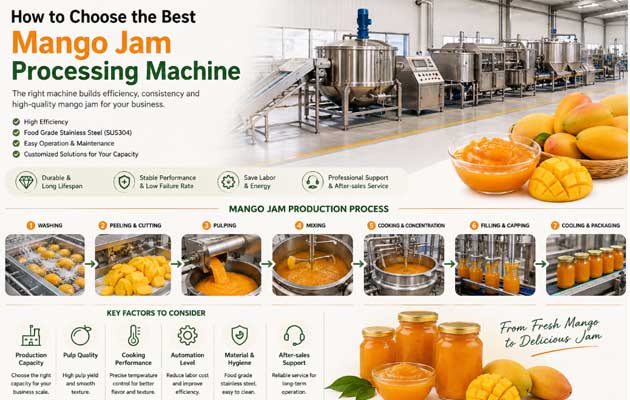
Fresh mango → Washing → Peeling & Cutting → Pulping → Mixing → Cooking → Concentration → Filling → Capping → Cooling → Packaging
Different manufacturers may use different processing methods depending on the required product texture, capacity, and formulation.
Therefore, it is better to choose a complete processing solution rather than selecting individual machines without considering the entire production process.
2. Choose a Machine According to Production Capacity
Production capacity is one of the most important factors.
For small businesses, a compact or semi-automatic system may be sufficient. Larger food factories may require a fully automatic mango jam production line with continuous processing.
For example:
- Small-scale production: suitable for startups and small food businesses
- Medium-scale production: suitable for growing manufacturers
- Large-scale production: suitable for commercial food factories and export-oriented businesses
Choosing equipment with the right capacity helps avoid unnecessary investment while ensuring that the production line can meet future demand.
3. Pay Attention to Mango Pulp Quality
The quality of mango pulp directly affects the final jam.
A good mango pulping machine should efficiently separate mango pulp from the skin and seeds while maintaining a consistent pulp texture.
For commercial production, the equipment should provide:
- High pulp recovery
- Consistent pulp texture
- Low material loss
- Easy cleaning
- Food-grade contact materials
For manufacturers processing different mango varieties, adjustable processing parameters can also make the equipment more flexible.
4. Consider the Cooking and Concentration System
Cooking is a key step in mango jam production. It helps develop the desired flavor, texture, and concentration.
Industrial mango jam processing equipment can use controlled heating and mixing systems to provide more stable processing conditions.
A suitable system should allow manufacturers to control important parameters such as:
- Temperature
- Cooking time
- Mixing speed
- Product concentration
Precise control can help reduce variations between batches and produce more consistent mango jam.
5. Look for Food-Grade Materials
Because the equipment comes into direct contact with food, material selection is very important.
SUS304 stainless steel is commonly used for food-processing equipment because it is durable, corrosion-resistant, and relatively easy to clean.
When evaluating a mango jam processing machine, check:
- Product-contact materials
- Welding quality
- Surface finish
- Cleaning accessibility
- Sanitary design
A hygienic machine design can help manufacturers maintain food safety and simplify daily maintenance.
6. Check the Level of Automation
Automation can significantly affect labor requirements and production efficiency.
A semi-automatic system may be suitable for small-scale production, while larger factories can benefit from PLC-controlled automatic systems.
Depending on the production requirements, automation can be applied to:
- Mango feeding
- Pulping
- Mixing
- Cooking
- Concentration
- Filling
- Capping
- Conveying
A higher level of automation can reduce manual operations and improve production consistency.
7. Consider Cleaning and Maintenance
Mango jam contains sugar and fruit pulp, which can leave residues inside processing equipment. Therefore, easy cleaning should be an important consideration when purchasing equipment.
Look for machines with:
- Smooth internal surfaces
- Easy-access components
- Simple dismantling
- Convenient water cleaning
- Hygienic piping and valves
Easy maintenance can reduce downtime and help keep the production line operating efficiently.
8. Don’t Choose a Machine Based Only on Price
The cheapest machine is not always the most economical choice.
When comparing different suppliers, consider the total cost of ownership, including:
- Initial equipment investment
- Energy consumption
- Labor requirements
- Maintenance costs
- Spare parts
- Production efficiency
- Expected service life
A machine with a slightly higher initial cost may provide better long-term value if it offers higher efficiency, lower labor requirements, and more reliable operation.
9. Choose a Supplier That Can Provide a Complete Solution
For commercial mango jam production, buying individual machines from different suppliers can make installation and production management more complicated.
A professional food machinery manufacturer can provide a complete mango jam processing line, including equipment selection, production flow design, installation, commissioning, and technical support.
This is particularly useful when you are building a new factory or expanding an existing fruit-processing business.
Conclusion
Choosing the best mango jam processing machine depends on more than machine price. Production capacity, mango pulp quality, cooking performance, automation, sanitary design, maintenance, and supplier support should all be considered.
For small producers, a compact semi-automatic system may be enough. For commercial manufacturers, a customized automatic mango jam production line can provide higher efficiency and more consistent product quality.
Before purchasing, clearly define your raw material, required capacity, final product specifications, packaging method, and budget. This will make it easier to select the right equipment and build a mango jam production line that fits your business.